
Have you been drawn to the chirp of birds while stuck in traffic? Did you ever peer into a pond to observe the hidden life in it? Have you ever walked in a park and wondered at the flowers and the butterflies?
We often imagine cities as busy places full of dust, noise, and speeding life. Yet cities are also home to the quiet life of trees, birds, insects and a host of other flora and fauna.
Most of it is invisible to us because we’re not looking for it. Yet, if we pay attention, we’ll realize there is a teeming world full of flurrying activity—as engaging (or even more) as any OTT series we’re bingeing on.
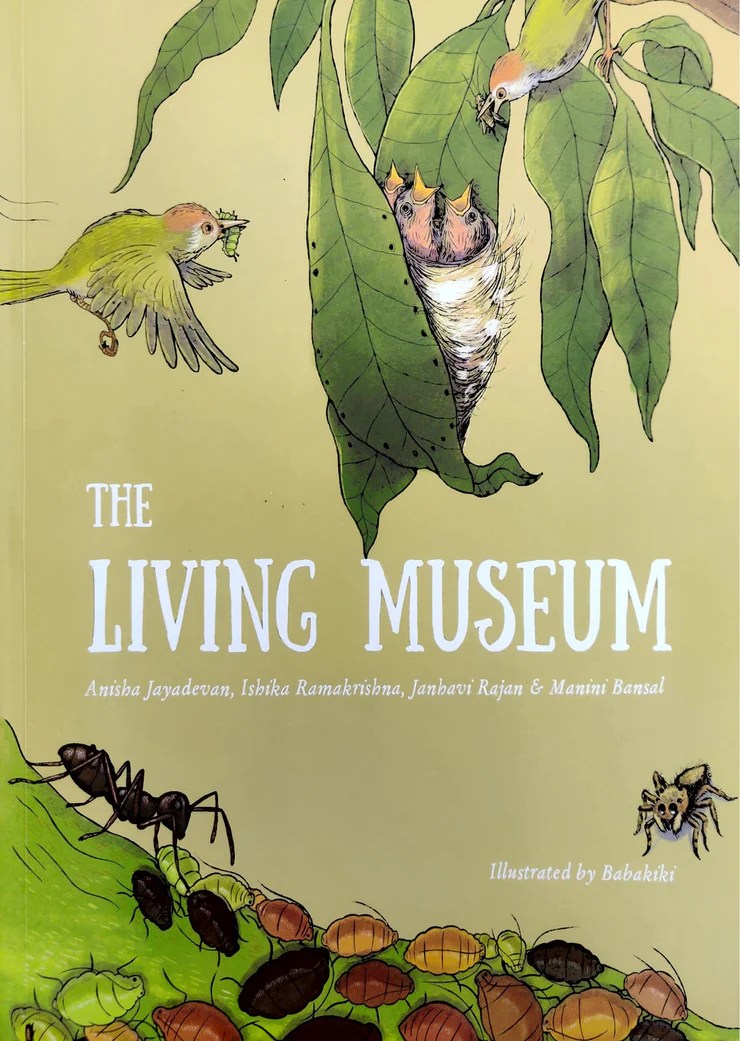
It’s almost like a living museum full of exhibits that surround us. It’s this magical world of plants, animals, birds, and insects that the book, The Living Museum, captures—not just with words but illustrations as well.
Meet Jumping Spider: The Hairy Hunter and Living Museum Guide
One morning last week, while gazing at the plants in my small balcony, I noticed something glint in the sun. Upon close notice, I found a tiny spider scramble away. As I inspected some more, I noticed an extremely fragile web of nest masterfully crafted by this architect.
Who knew that I would encounter this fellow again (probably a Jumping Spider aka The Hunter) in a book just a week later! Well, yes. This itsy-bitsy spider is the guide to the awe-inspiring Living Museum.
The Creators (And Curators) of the Living Museum
The creators of this ‘illustrated book on urban biodiversity in India’ are Anisha Jayadevan, Ishika Ramakrishna, Jahnavi Rajan, Shishir Rao, and Manini Bansal who form the collective, Café Oikos. The vibrant and sweeping illustrations are the handiwork of Fahad Faizal and Sunaina Coelho who form the art and design studio, Babakiki. Support for this book has also come from organizations, such as The Foundation for Ecological Research Advocacy and Learning (FERAL), Bengaluru Sustainability Forum (BSF), and Nagarathna Memorial Grant.
Together, their efforts make an overlooked world come alive. The treasure trove of a book is filled with nuggets of information about the astounding worlds of the living museum. The ‘halls’ where the living exhibits abound in are the indoors, the garden, the roadside, and at night time.
The Inhabitants of the Living Museum
I learnt from The Living Museum about the surprising mating habits of different insects. For example, did you know that the female bagworm attracts the male one through pheromones? Can you imagine that the adult female praying mantis eats up their male mate? I was blown over by how black kites put on a spectacular display while breeding.
That’s not all. These nature’s tricksters are also masters of camouflage. In fact, the common mormon is known as the master of deception since it drapes distasteful costumes to ward off predators. The plain tiger caterpillar does the same. It absorbs toxic substances from the giant milkweed plant which makes them distasteful to eat, driving off predators. Talk about survival strategies!
There are tons of more such fun, eyebrow-raising, and mouth-opening facts and anecdotes about our not-so-familiar neighbours. “We wanted this book to dig deep into the fascinating seasonal changes, behaviours and interactions you can observe in a city — for example, during their breeding season, white cattle egrets sport orange feathers which make them look more attractive to females.” Anisha Jayadevan shares in an interview.
An Important Lesson (And Reminder) About Urban Biodiversity
This urban biodiversity is incredibly important for our cities and human life.
“Bangalore’s large canopied trees are islands of shade for all classes of citizens, providing aesthetic relief and a break in concrete landscapes. Their functional value however exceeds their aesthetic appeal. ATREE’s studies show a dramatic 5ºC maximum difference in temperature and a maximum of 20 percent increase in humidity at mid-day between tree-lined and bare stretches of the same street. Suspended particulate matter on stretches of road without trees was as high as four times the permissible limits of 180µg/m3, but reduced to near permissible limits when trees were present; obviously serving as a partial sink for airborne pollution.” reports ATREE.
The Living Museum satiates our curiosity about the natural world and offers us ways on how we can connect with this world through our senses: sight, sound, smell, and touch. It acts as a precursor to the experiential way we can learn about nature around us.
However, this guided tour to the thriving museum of the natural world doesn’t stop at just sharing eye-opening facts. It also delves into the world of urban ecology and citizen science. It ponders on the effects of climate change on the seasons and internal clocks of the inhabitants of the Living Museum. It reminds us that our cities and we are a part of nature and won’t be able to exist by swallowing up the ecosystem that makes up the Living Museum. Finally, as a ray of hope, it offers us solutions on how we, as citizens, can ask the right questions and contribute to conserving the Living Museum.
A World for Young and Curious Minds To Explore
The Living Museum is a great guide for budding youngsters to take an interest in the natural world. The simple, exuberant prose and the uplifting pictures can draw young minds to the exciting world of nature around them.
Anisha too believes that there’s a lot we can do as adults to immerse children in this world. “Just taking children out for a walk in the park or pointing out bird calls, insect homes and flowering or fruiting trees from your home can help them develop curiosity. Asking questions about what they observe also helps to make connections and draw patterns — for example, discuss what a bird or insect uses to build its nest? Where is it nesting? Which month is it building its nest in?” she suggests.
After all, they are our beacons of hope in a dying world.

Leave a comment