
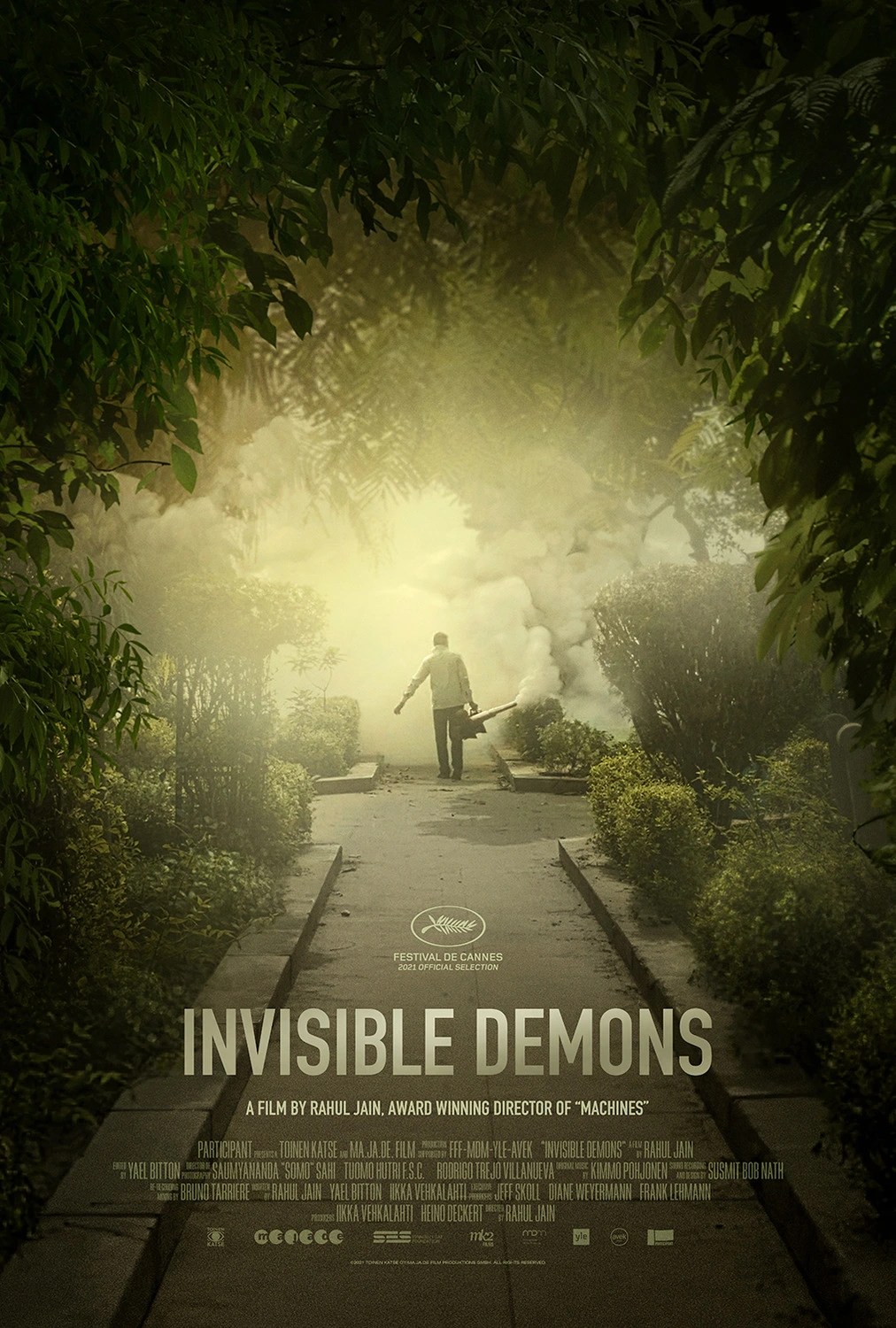
A pristine green garden gets engulfed in a foul, grey smoke. A suspenseful music plays as the camera patiently waits for us, the viewers, to gauge the horror of the scene.
Rahul Jain’s Invisible Demons prepares us for the set of haunting frames his documentary feature is going to inflict on us for the next 70 minutes. Screened at the ‘Cinema for the Climate’ section at the 74th edition of the Cannes film festival, it’s a painfully patient observation of how the climate crisis pans out in the capital city of Delhi, India.
Cinematographers Saumyananda Sahi, Tuomo Hutri, Rodrigo Trejo Villanueva stitch jolting panoramas together that shake us to the immediacy and urgency of environmental devastation. Their camera flits between macro and micro to capture the nuances, scale, and scariness of the climate predicament.
A couple of women clad in colourful saris stand praying in the Yamuna river, stark against the white of the gloomy sky and the piles of industrial foam enveloping the water. A herd of cows chomp on dumped plastic. People living in colonies throng a water truck to get their daily ration and carry the heavy barrels back to their dingy homes. A flock of birds hover over a dump yard, a scene that looks straight out of apocalypse. Smoke blows out of a mountain of garbage pile, one of the city’s many landfills.
The intersectionality of the climate crisis stands out. While the affluent can afford ACs and air purifiers, the marginalized are forced to slog in toxic fumes, hazardous waters, and smoggy air. There is no respite. The double-edged sword of resource scarcity and climate impact hangs over their distraught lives. They are the victims, whatever the crimes.
Speaking about the relationship between climate crisis and inequality, Jain muses, “I think it is causing massive inequalities in India because it is happening in a place where hierarchies are omnipresent. This will only widen the gaps in the hierarchies. But of course, no matter how much privilege of any kind you may have, you can’t escape the polluted sky. Maybe you can build a castle, stay in it and filter everything that comes in and out but I’m not sure this is the way to live your life. So in that way, all the classes are going through this. We all have the same body, we breathe and feel at the same time. Consequently, climate change harms everyone equally.”
Writers Rahul Jain, Yael Bitton, Iikka Vehkalahti peer with an unflinching gaze at the apathy in governance, the nonchalance of the wealthy, and the plight of the poor. Their writing lays bare the perils of urbanization, the horrors of population growth, and the harrowing effects of industrialization.
The origin of the story came from personal experience. Jain shares, “I went to Bhutan for a month and I was very happy and I guess my immune system was very happy too. I landed back in Delhi and my lungs immediately gave away. Because the air in Bhutan is very clean, within one hour the switch, or the flip must have been too much of a jump for my body to handle. It made me very, very sick. So I realized, at that point I was 25, 26 and if my body is giving away so fast, then Delhi being this ultra-megalopolis, with a very unevenly distributed age bracket, there must be so many casualties.”
In fact, the winner of the Jussi Award for Best Documentary makes us reflect how the environment is personal and political. Our personal choices on consumption, wastage, waste management and segregation, lifestyle and entertainment choices ultimately have an impact on the environment. Our wealth may protect us from bearing the brunt of it, but not for long. The rising temperatures, the soaring prices and fares, the unending traffic are proof to the dark underbelly of development we reside in.
As the camera returns to a green paradise with a cow grazing in it, we are forced to reflect on a life without development, not without a tinge of nostalgia.
Invisible Demons is produced by Diane Weyermann, Jeff Skoll, Frank Lehmann, Jaya Jain, Iikka Vehkalaht, and Heino Deckert.
It is available for viewing on MUBI.

Leave a comment