
It was right after lunch. The air would be heavy with perspiring kids freshly back from the lunch break. Everyone will be tired and sleepy. That’s when the history teacher will walk in. The chapter was Mughal rule in India.
This bit of memory from school flashes back. That was the last time I read about the Mughals. Of course, there have been brilliant books in between by William Dalrymple, Manu Pillai, Ira Mukhoty, Audrey Truschke, Irfan Habib, Jadunath Sarkar, and many others. There have been some splendid films as well.
Somehow, in the midst of reality, I didn’t get a chance to immerse myself in the ancient world of the Mughals.
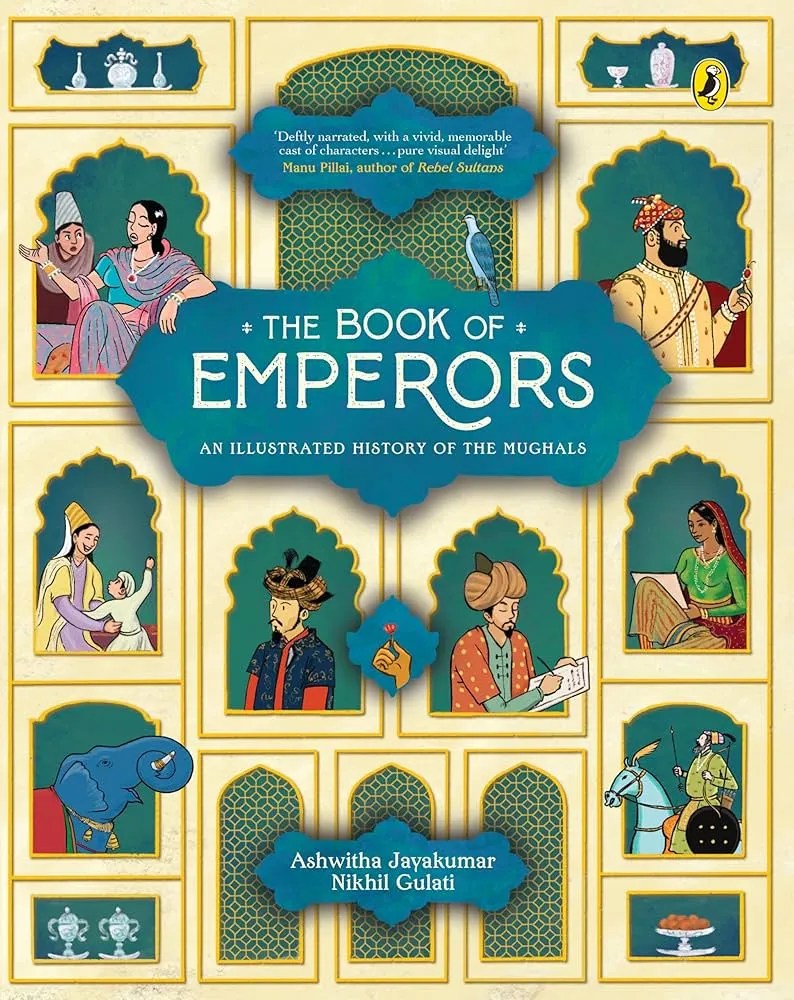
Until I got hold of this book – The Book of Emperors: An Illustrated History of the Mughals , written by Ashwitha Jayakumar and illustrated by Nikhil Gulati.
“History would call them the Mughals. ‘The Book of Emperors’ tells their stories”
The Book of Emperors: An Illustrated History of the Mughals
Reading the blurb—an excerpt above—and looking at the illustrations already made me curious. This didn’t seem like a book stuffed with information, but stories.
I decided to start reading.
Once I finished reading, I congratulated myself for the decision. The book made me feel a strange kinship with the erstwhile rulers, a pride in our multicultural history, and a tinge of nostalgia for the glory of bygone times.
What stood out for me was how the Mughal rulers were humanized: through their life-like illustrations, accounts of their triumphs and downfalls, glories and follies. It dived into the temperaments of the rulers—outside of the empire—and observed their passions and leanings, ranging from wine to poetry to art.
The book also doesn’t flinch to unravel the multiple layers of the emperors: ruthless kings, patrons of art, doting sons, conspiring relatives…colorful personalities.
Jayakumar acknowledges about how she wanted the book to pan out, “I wanted to convey all of the chaos, the colorful characters and the complexity of the Mughal world using a narrative history approach, incorporating anecdotes from primary sources to tell a story that’s fun to read while also being informative.”
She succeeded, for sure.
What carries the book along the pages of history are the sweeping illustrations. They grow, like a beautiful vine, along every corner, side, and space in the book. The subjects vary from pottery to fruiting trees to mourning kings to majestic hills. They bring out the fascinating era of the Mughal rule in India alive.
Nikhil Gulati, an award-winning author and illustrator, talks about his inspiration, “The art of the book draws heavily upon the large collection of Mughal miniature paintings that depict the people, places and events spanning three centuries. We cannot go back in time and see what the Mughal world really looked like, but my goal was to give a flavor of the times, based on their art, so that the reader can imagine it for themselves.”
In an era of experiential learning for children, this book sets the tone and pace for grasping the 300-year-old history into 130 pages in a format that intrigues rather than overwhelms.
Ashwitha muses about the format, “The study of history involves understanding the contours of places and times removed from ours, and how they shaped people’s lives and choices. It’s about empathy and understanding, making connections and getting to the roots of social mores, ideals and practices we still follow. That’s why I think it’s important to present history in a way that is relatable and interesting, not just to young readers but to anyone.”
The book creates a chapter out of each emperor, right from Babur in 1526 to Bahadur Shah Zafar in 1857. The mini chapters highlight specific aspects of the Mughal rule, such as painting, princesses, feasts, routines, and more.
All in all, this gem of a book reignites in the minds of the young a curiosity for a history that’s slowly fading away.

Leave a comment