

I was born in 1991. Beastly Tales from Here and There by Vikram Seth came out in 1992, a year later. I first read a poem from it in 2025, this year, that too from a different anthology.
The poem, The Elephant and The Tragopan, talks about the perils of human greed and how it affects the environment and the interconnected biodiversity. The origins of what might have propelled Seth to write the eco-poem are a full-blown catastrophe today.
Sitting in 2025, having collectively witnessed countless cyclones, tsunamis, forest fires, virus outbreaks, and record-breaking climate changes as a civilisation, I realise how relevant the poem still is. The realisation is scary, to say the least.
Ecocriticism as a Concept
Eco-consciousness (individual/community concern for the environment) predates ecocriticism (literary/cultural analysis of human-environment relationships) because our ancestors and ancient civilisations have understood the interdependence between humans and the environment.
Environmental consciousness or eco-consciousness reflected in English literature too in the Romantic era with Romantic poets, such as William Wordsworth, Samuel Taylor Coleridge, and John Keats, exploring the connections between nature and man in an emotional and spiritual level.
The growing environmental movement laid the foundation of eco-criticism in the 20th century. Rachel Carson’s seminal work, Silent Spring (1962), paved the way for eco-critical analysis. In 1978, William Rueckert coined the term ‘eco-criticism’ with his essay, Literature and Ecology: An Experiment in Ecocriticism.
Ecocriticism in Indian Poetry
Eco-critical themes too found a place in India’s rich literary heritage. In the works of poets, such as Toru Dutt, Sarojini Naidu, A.K. Ramanujan, and Dilip Chitre, nature was a central character and took many forms—nurturer, sacred being, or companion.
Vikram Seth, a prominent name in the world of Indian Writing in English, deals with several ecocritical themes in his works. The Beastly Tales from Here and There (1991) is a collection of poems that are eco-centric in nature, humanising its animal characters to portray their moral agency juxtaposed against human immorality.
The Elephant and The Tragopan: An Eco-Poem About a World in Crisis
All Is Not Well in Bingle Valley

The Elephant and The Tragopan, an 800-line long poem, the last and longest in The Beastly Tales from Here and There, unveils the stark distinction between anthropocentrism (human-focused worldview) and ecocentrism (nature-focused worldview).
It begins with an idyllic picture of paradise filled with natural beauty, peace, and harmony:
“In Bingle Valley, broad and green,
Where neither hut nor field is seen,
Where bamboo, like a distant lawn,
Is gold at dusk and flushed at dawn,
Where rhododendron forests crown
The hills, and wander halfway down
In scarlet blossom…”
However, this ‘minor paradise’ in Bingle Valley is not safe from the cruel and greedy clutches of man. This is what the Elephant and the Tragopan start discussing.
Note: Tragopan is an Asian bird belonging to the pheasant family, known for their bright, spotted skins. India has four of the five species of tragopans in the world. Tragopans in India face a habitat crisis, especially the western tragopan.
The Tragopan caught news from a gossipy bird about a ‘crazy scheme’ to take over their land and exploit it for wood and water. A week later, the Bingle Telegraph reports a sinister plan of turning their stream into a dam to meet the needs of a nearby city.
The scheming culprit? Great Bigshot Number One – Shri Padma Bhushan Gobardhun.
The Beastly Board Discuss the Selfishness of Man
This sudden catastrophe calls for a meeting of The Beastly Board of Forest Folk that includes a motley group of animals, from the gibbon to the trout, the cat to the quail, and the leopard to the leech.
Amidst heated arguments, the Elephant draws attention to the nature of man to destroy everything beautiful for their selfish ends:
“The sticky centre of this mess
Is an uneasy selfishness.”
He very well understands the hierarchy of power and where the animals stand:
“For of all creatures, man comes first.”
And how they think everything in the world is for them to exploit:
“He sees the planet as his fief
Where every hair or drop or leaf
Or seed or blade or grain of sand
Is destined for his mouth or hand.”
He points out the many ways in which man exploits animals:
“He rips our flesh and tears our skin
For cloth without, for food within.
The leopard’s spots are his to wear.
Our ivory unknots his hair
The tragopan falls to his gun.
He shoots the flying fox for fun.
The black bear dances to his whim.
My own tame cousins slave for him.”
And yet, even after all the sacrifice, the animals fail to get any credit:
“Yet we who give him work and food
Have never earned his gratitude.”
The dichotomy of man is displayed well here, of how they worship the animals yet never hesitate to take advantage of them:
“And yet despite this fertile fuss,
When has he truly cared for us?”
There Is Nowhere Left To Go
The animals collectively discuss options on how to deal with this catastrophe. The solidarity rings through everyone:
“We must unite in fur and feather—
For we will live or die together.”
But a solution is yet to come. Charging to the town and burning it down will only get them “arrested. /Or maimed or shot or even eaten.” Some suggest that they should move far away from the purview of humans. Yet even that seems like a distant reality since “A distant valley is indeed /No sanctuary from his greed.” because “nowhere lies beyond man’s reach”.
And so, they decide to take a rally to town.

The Wily Workings of the World of Men
The simple group of animals are yet unaware of the crooked workings of man. As they make their way to town, the villagers come out to watch them, and even cheer or join them.
Great Bigshot’s Number Two, scarily informs him about the approaching group, who didn’t care to go through the ‘Protocol Protection Panels’ or the ‘Riffraff Registrar’. The interaction between Great Bigshot and Number Two clearly reflects the cycle of intimidation and exclusion which power thrives on. Number Two does his bit by identifying the ‘leader of the bunch’, the Tragopan.
Bigshot uses all his tricks to dissuade the group of protestors. He first brushes them off with busyness. But then, sensing their resolution, he “turned from awe to elocution.” He tries to evade responsibility next, concluding that he has no power in his hands. Next, he tries to drown them all in absurd and unnecessary paperwork:
“But if next year in early fall
You fill, in seven copies, all
The forms that deal with such a case
And bring them over to my place
Together with the filing fees
And three translations in Chinese,
The Council, at my instigation,
May give them due consideration.”
He makes the deal sweeter with some bribe:
“I will
Invite you to a mighty feast
Where every bird and every beast
Will sup on simply super food,”
Once he figures the animals are in no mood to be mollycoddled or fooled, he decides to play divide and rule. He seeks out a representative from the big group—a handful is definitely easy to manipulate than a hundred, after all.
Satire Or Reality?
The negotiation proceedings would seem dystopian, had it not been so familiar to our reality.
In the one on one discussion between Bigshot and Number Two on one hand and the Elephant and his Secretary, the Tragopan, on the other, Bigshot resorts to public good as his weapon:
“It’s for the people that I act.”
Then, he dismisses them with a consolation:
“We’ll relocate you all somehow
In quarters of a certain size.”
The Tragopan seemed to be ready for this. He pulls out his papers and quotes facts that give Bigshot ‘indigestion’.
“And why is it that Minister’s Hill
And Babu’s Barrow drink their fill
Through every season, dry or wet,
When all the common people get
Is water for three hours each day?”
This passage uncannily depicts the unequal distribution of wealth and resources among the rich and the poor. The Tragopan rightfully demands for a ‘radical distribution’.
All That Matters Are Votes
Bigshot tries to put up a brave front and hints at the Tragopan’s naivety. He points out:
“Redistribute it night and day,
Redistribute it all away,
Ration each drop, and you’ll still find
Demand will leave supply behind.”
The Elephant steps in. His simple mind can’t understand why the men are obsessed with their land when their own administration is crumbling. Surely, one can solve the problem with a few fixes:
“During your long administration.
Your pipes cry out for renovation,
Your storage tanks corrode and leak,
The valves are loose, the washers weak.
I’ve seen the water gushing out
From every reservoir and spout.
Repair them; it will cost far less
Than driving us to homelessness”.
The Elephant also points at sustainable development as solutions:
“Plant trees; revive your wells and springs.
Guide from your roofs the monsoon rain
Into great tanks to use again.
Reduce your runoff and your waste”.
Bigshot sighs and comes down to basics. The animals really have no sense of how things work.
“I think you fail to comprehend
What really matters in the end.
The operative word is Votes,
And next to that comes Rupee-notes”.
The Elephant realises that their ‘vocal throats’ are no match for man’s ‘thirsty dreams’.
An Intimidation and an Interruption
The Bigshot realises he has revealed his real intentions. So, the animals are now a liability.
“Sadly, since you’re now in the know,
I can’t afford to let you go.”
He also wants to set a record to ensure that no other animal dares to revolt against him.
“From this the other beasts will learn
Your lands are ours to slash and burn
And anyone defying man
Will be a second tragopan.”
Unless, of course, the animals accept to be bribed to silence:
“And I’ll make sure
You’ll be—let’s say—provided for.”
Just as Number Two tries to commit to violence, Bigshot’s son, Smallfry, arrives to the scene.
Smallfry’s entry offers a much-needed respite and a ray of hope. Perhaps all is not lost. This generation is not entirely corrupted. There’s still some humanity left.
Smallfry dwells on childhood memories of a green and biodiversity-rich paradise that will be destroyed with his father’s unscrupulous acts.
“How many worlds like this remain
To free our hearts from noise and pain?
And is this lovely fragile vision
To be destroyed by your decision?”
His fears are not unfounded since most of what he refers to: ‘pleasure lake’, ‘motorboats’, ‘loudspeakers’, ’ferris wheels’, and ‘forest fires’ are what we find in today’s peaceful havens, marked by overpopulation and over tourism.
The Cycle of Wealth Transfer
Bigshot, angry at the rebuttal, curses his son for his blindness. He brings up the classic point of anti-intellectualism—certainly his education is at fault:
“Your education’s made you weak—
A no-good, nattering nature-freak”.
Bigshot questions his hypocrisy: how after enjoying all his privilege can he go against him?
“You’ve been brought up in privilege
With Coca-Cola in your fridge
And litchis in and out o f season.
How dare you now descend to treason?”
With disappointment, he cries out how Smallfry doesn’t see, in his foolhardy idealism, that the intergenerational transfer of wealth and the gatekeeping of capital will secure his future.
“One day all this would have been yours—“.
Chaos and a Death
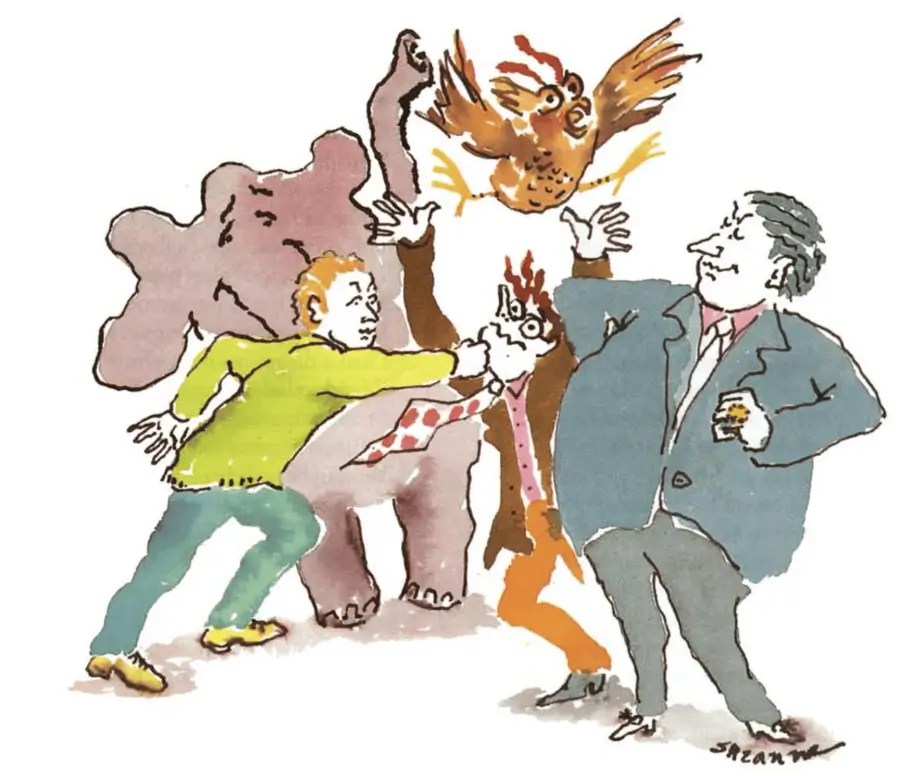
Chaos erupts with the animals and man engaging in a clash, as the guards rush in. Confusion arises. The press takes advantage of the opportunity to boost their TRPs.
Tragopan makes the mistake of provoking violence and meets his tragic end.
“Provoked by a pernicious peck,
The Bigshot wrung its little neck.
The tragopan collapsed and cried
“Gock gock!” and rolled his eyes and died.”
The Tragopan becomes a martyr, receives a state funeral, and becomes a hero among all.
While this leaves Bingle without a leader, other things start to be at play.
Seth cleverly depicts here the curious cases of media trial. With the media’s growing powers, often truth takes a different form.
In this case, it shoots Bingle Valley to fame, but also puts them in the limelight. Intellectuals dive into all kinds of debate, dissect the Tragopan’s intentions, and criticise Bigshot’s morals.
A Fable Without a Moral
Seth ends the eco-fable on an ambiguous note. He refrains from offering a moral:
“This is a tale without a moral.”
He does offer two ‘quasi-morals’ which are rooted in reality. He doesn’t see the world in rose-tinted glasses, hence advises to keep doing your work in silence instead of expecting too much fanfare:
“You may as well work for your cause
Even without overt applause;”
The second one offers some hope. During our struggle, we may find friends in unlikely places:
“…you’ll find friends
In the most unexpected places,
Hidden among unfriendly faces—“
With that he ends since the destiny of the world is not for writers or poets to decide, it’s written by time itself.
“The resolution of their plight
Is for the world, not me, to write.”
Sources
- Cover photo courtesy: Bhavi Mehta. https://www.bhavimehta.com/new-page-57
- Images courtesy: Suzanne Dunaway https://suzannedunaway.com/
- Bharathi, C. “ECOCRITICAL READING OF VIKRAM SETH’S THE ELEPHANT AND THE TRAGOPAN.” Language in India, vol. 17, May 2017, pp. 1-10. Language in India, www.languageinindia.com/may2017/bharathielephantpoem1.pdf.
- Rani, N. S. Usha, and P. K. Murugan. “A STUDY OF ECOCRITICAL CONCERNS IN VIKRAM SETH’S POETRY WITH SPECIAL REFERENCE TO ‘THE ELEPHANT AND THE TRAGOPAN’.” NANO: Journal of Contemporary Research, vol. 15, no. 1, 2024, pp. 1-7. NANO: Journal of Contemporary Research, nano-ntp.com/index.php/nano/article/view/3789.
- Singh, Gagan, and K. S. Lakshmi. “Human and Nature Connection: An Ecocritical Study of Vikram Seth’s ‘The Elephant and the Tragopan’.” International Journal of Financial Accounting and Natural Sciences, vol. 8, no. 1, 2023, pp. 1-6. International Journal of Financial Accounting and Natural Sciences, http://www.ijfans.org/uploads/paper/eaa9de30cf4415ee94c472319147f2ac.pdf.
- Balaji, G. “Reflection of Ecocriticism in Indian Poetry.” International Journal of English Language Studies, vol. 6, no. 4, Aug. 2021, pp. 172-74. International Journal of English Language Studies, ijels.com/detail/reflection-of-ecocriticism-in-indian-poetry/.
- Bharathi, C. “THE ELEPHANT AND THE TRAGOPAN IN BEASTLY TALES FROM HERE AND THERE OF VIKRAM SETH AS AN ECO-POEM.” International Journal of Research and Analytical Reviews (IJRAR), vol. 6, no. 2, June 2019, pp. 340-43. Academia.edu, http://www.academia.edu/44432324/THE_ELEPHANT_AND_THE_TRAGOPAN_IN_BEASTLY_TALES_FROM_HERE_AND_THERE_OF_VIKRAM_SETH_AS_AN_ECO_POEM.

Leave a comment